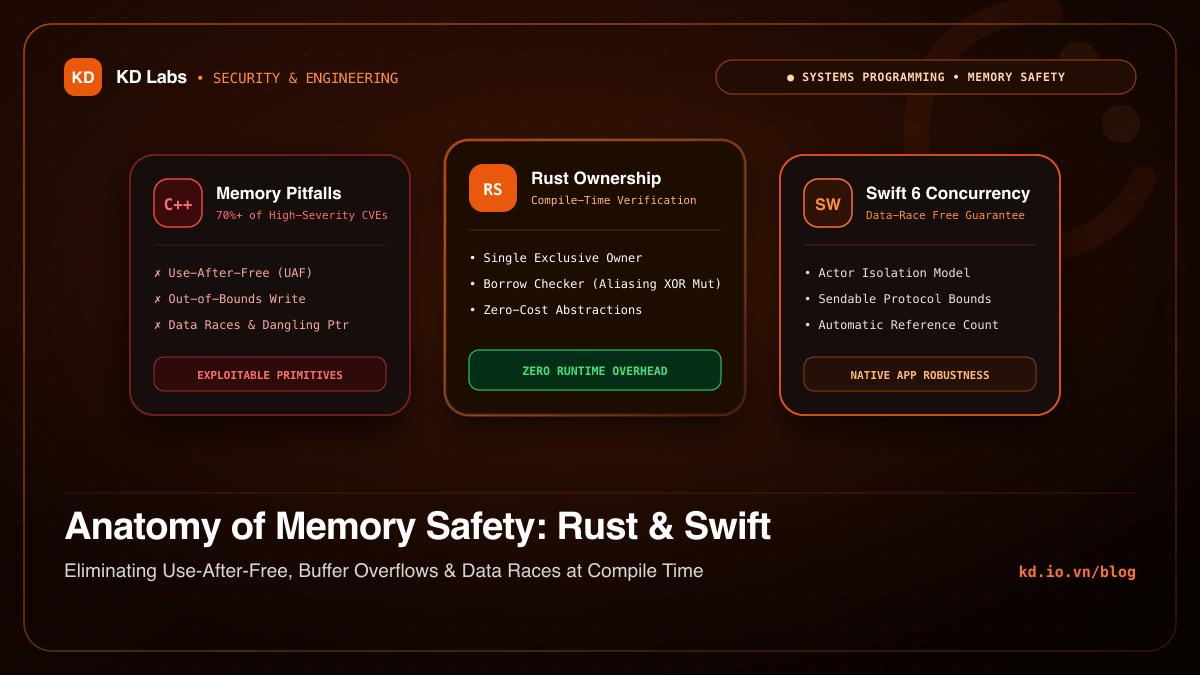
For nearly half a century, C and C++ have reigned as the undisputed monarchs of low-level software engineering. They power everything from the Linux, Windows, and macOS kernels to browser rendering engines (Chromium, WebKit), hypervisors, telecommunications firmware, and foundational cryptographic libraries (like OpenSSL). C and C++ deliver unmatched low-level hardware control, predictable execution latencies, and raw bare-metal performance.
Yet this absolute developer freedom has exacted an astronomical toll: Memory Safety Vulnerabilities.
Historical telemetry from the Microsoft Security Response Center (MSRC) and the Google Chromium Security Team reveals a striking reality: over the past 15 years, roughly 70% of all severe security vulnerabilities (CVEs) trace their origins directly to manual memory management bugs. This startling proportion prompted joint advisories from the U.S. National Security Agency (NSA), Cybersecurity and Infrastructure Security Agency (CISA), and the White House Office of the National Cyber Director (ONCD), urging the technology sector to systematically migrate away from memory-unsafe languages.
1. Dissecting the 3 Classic Memory Flaws in C/C++
To appreciate why modern systems engineers are transitioning to memory-safe languages, we must inspect the mechanics of the three most pervasive memory corruption primitives:
1.1. Buffer Overflow (Out-of-Bounds Write)
Occurs when an execution routine writes data beyond the boundary of an allocated array on the stack or heap, clobbering neighboring memory cells.
// Vulnerable C pattern:
void process_packet(const char *untrusted_input, size_t input_len) {
    char stack_buffer[64];
    // Missing boundary check -> Buffer Overflow!
    memcpy(stack_buffer, untrusted_input, input_len);
}
An attacker supplying crafted binary payloads can overwrite adjacent stack frames, including the Return Instruction Pointer (RIP), hijacking instruction flow to execute arbitrary shellcode at the caller’s privilege tier.
1.2. Use-After-Free (UAF)
The predominant root cause behind modern browser exploits and mobile kernel privilege escalations:
struct SessionVault *vault = malloc(sizeof(struct SessionVault));
// ... perform cryptographic operations ...
free(vault); // Memory released back to the operating system allocator!

// CRITICAL FLAW: Dangling pointer remains live in memory
vault->is_authenticated = 1; // Overwrites reallocated memory owned by another subsystem!
When subsequent allocations claim the identical virtual memory address, accessing the stale pointer corrupts the newly allocated data structure, often yielding arbitrary memory read/write primitives.
1.3. Multi-Threaded Data Races
A data race transpires when two or more concurrent execution threads access the same memory location simultaneously without synchronization (such as a mutex), and at least one access is a write operation. Data races cause undefined behavior, torn reads, and state corruption that defy reproducible debugging.
2. The Rust Paradigm: Compile-Time Verification Without Garbage Collection
Prior to Rust, computer science posited an immutable trade-off:
- Choose Raw Speed and Control: Write C/C++, accepting persistent risks of memory corruption and crashes.
- Choose Safety: Write Java, Go, C#, or Python, accepting the non-deterministic pauses of a Garbage Collector (GC), inflated memory footprints, and high barriers to bare-metal systems interfacing.
Rust demolished this false dichotomy through Compile-Time Memory Safety via Zero-Cost Abstractions.
                   MEMORY MANAGEMENT ARCHITECTURES
 ──────────────────────────────────────────────────────────────────────────
 C / C++              Manual (malloc/free)       Prone to UAF & Buffer Overflows
 Java / Go / C#       Runtime Garbage Collector   Random GC pauses, higher memory
 Rust                 Ownership & Borrow Checker 100% Verified at Compile Time!
 ──────────────────────────────────────────────────────────────────────────
2.1. The Three Invariant Ownership Laws
The rustc compiler enforces three non-negotiable rules:
- Each value in memory possesses exactly one owner variable at any given moment.
- When the owner passes outside its lexical scope, the memory is dropped deterministically via the
Dropdestructor trait. - Values may be borrowed as references, strictly governed by the Aliasing XOR Mutability rule:
- You may instantiate any quantity of immutable references (
&T), OR - You may hold at most one mutable reference (
&mut T) simultaneously.
- You may instantiate any quantity of immutable references (
fn main() {
    let mut keys = vec!["KeyA", "KeyB"];
    let ref1 = &keys;       // Immutable borrow 1
    let ref2 = &keys;       // Immutable borrow 2 (Completely safe)

    // COMPILE ERROR: Cannot borrow `keys` as mutable because it is also borrowed as immutable
    keys.push("KeyC");

    println!("Vault contents: {:?}", ref1);
}
Through these checks, Use-After-Free and Data Races are eliminated during source code compilation. The binary simply will not build if a safety invariant is violated.
3. Swift 6 and Strict Concurrency on Mobile Platforms
While Rust excels in operating system kernels, cryptographic engines, and backend infrastructure, Swift is establishing the benchmark for memory safety within client applications and mobile ecosystems.
With the release of Swift 6, Apple mandated Strict Concurrency Checking, definitively eradicating data races across asynchronous execution contexts:
3.1. Thread Isolation Through the Actor Model
An actor in Swift isolates its state from the rest of the application, guaranteeing that only a single task mutates or reads its mutable variables at any instant:
actor SecureVaultActor {
    private var tokenStore: [String: String] = [:]

    func persistSecret(account: String, secret: String) {
        tokenStore[account] = secret
    }

    func readSecret(account: String) -> String? {
        return tokenStore[account]
    }
}
Any external caller attempting to access SecureVaultActor must yield control via await. Swift’s type system enforces that arguments crossing actor isolation boundaries conform to the Sendable protocol, ensuring no unsynchronized references can leak into competing threads.
4. Comprehensive Systems Programming Matrix
| Dimension | C / C++ | Go | Rust | Swift 6 |
|---|---|---|---|---|
| Memory Safety | ❌ Manual (High vulnerability risk) | ✅ Safe (Managed by GC) | ✅ Absolute (Verified compile-time) | ✅ Absolute (ARC + Compile-time checks) |
| Deallocation Mechanism | free() / Manual RAII |
Garbage Collector | Deterministic RAII / Drop |
Automatic Reference Counting (ARC) |
| Data Race Defense | ❌ Manual locks required | ⚠️ Runtime race detector | ✅ Guaranteed compile-time | ✅ Strict Concurrency & Actors |
| Runtime Overhead | Minimal (Zero abstraction cost) | Variable GC pause spikes | Equivalent to C/C++ | Optimized for Apple Silicon & ARM |
| Embedded & Kernel Applicability | Historic standard | Unsuitable for kernels | Native Linux Kernel & Firmware support | Embedded Swift profiles expanding |
5. Engineering Principles at KD Labs
At KD Labs, when architecting security utilities like Simple OTP, user data protection is never contingent upon developer vigilance alone. Developers are human; compilers backed by mathematical type theory are inexorable.
We build upon three strict security baselines:
- Defensive Boundary Guarantees: Ensure all decoding routines (such as Base32 parsing or
otpauth://URI handlers) operate within bounded, memory-safe data structures. - Explicit Memory Zeroization: Sensitive cryptographic key material residing in volatile RAM must be immediately scrubbed with zeros (
0x00) upon task completion to prevent exposure in process core dumps or swap partitions. - Continuous Migration to Memory-Safe Languages: Legacy C/C++ components should be progressively replaced with audited Rust modules or Modern Swift to shrink the attack surface down to zero.
The era of tolerating manual memory errors is over. Building with memory-safe languages is no longer a matter of stylistic preference—it is a non-negotiable security imperative for modern software engineering.