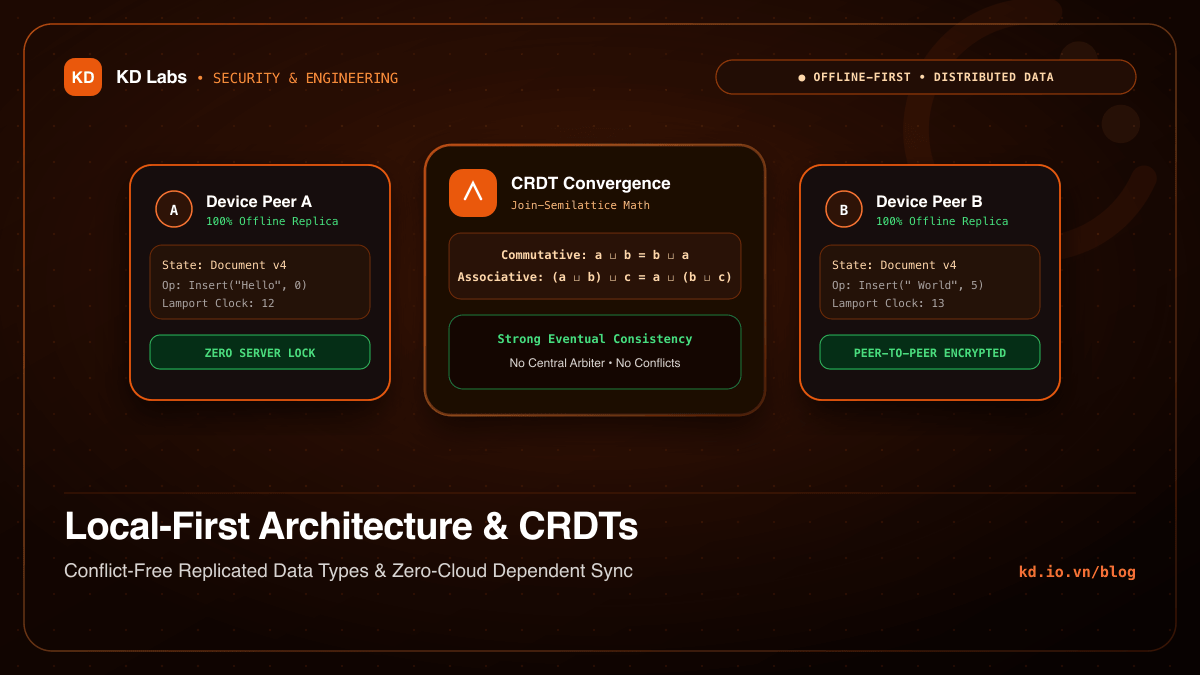
For the past twenty years, the Cloud-First / SaaS paradigm has been the unquestioned default of the software industry. From Google Docs and Notion to Slack and Figma, user state resides in centralized database clusters governed by corporate service providers.
While this architectural model delivers effortless real-time collaboration, it extracts severe systemic costs:
- Loss of True Data Ownership: If a cloud vendor shutters its operations, alters terms of service, or terminates an account, user data vanishes overnight.
- Latency and Network Fragility: Without an active Internet uplink, cloud-dependent applications degrade into unresponsive screens burdened by spinning loading wheels.
- Centralized Threat Vectors: Concentrating the private records of millions of people in centralized databases creates an irresistible honeypot for cybercriminals and unauthorized surveillance.
In response to these systemic vulnerabilities, an architectural counter-revolution has taken root: Local-First Software.
1. The 7 Ideals of Local-First Software
Articulated in seminal research by Ink & Switch in 2019, Local-First engineering establishes seven uncompromising tenets:
- No Spinners (Zero-Latency Local Execution): All reads and writes target local non-volatile storage on the client device first. User interactions complete in sub-millisecond timeframes.
- Multi-Device Autonomous Parity: Users can write notes, update spreadsheets, or edit models seamlessly across phones, laptops, and tablets concurrently.
- Network is Optional: Applications operate with full functionality for hours, days, or months off-grid without degraded capability.
- Seamless Collaborative Merging: When connectivity is restored, modifications authored independently by peer devices reconcile automatically without data loss.
- Data Longevity Across Decades: Documents persist in durable, accessible formats, remaining fully readable decades after the original software developer ceases operations.
- Security & Privacy by Design: Data is end-to-end encrypted (E2EE) before leaving the local device; sync relays act as blind brokers unable to inspect message payloads.
- Absolute User Sovereignty: Users retain unrestrained autonomy to copy, inspect, back up, migrate, or delete their data without requesting permission from a remote server API.
2. The Core Mathematical Engine: CRDTs (Conflict-free Replicated Data Types)
The fundamental engineering barrier in Local-First systems is: How can multiple detached nodes independently mutate the same data structure while offline, and guarantee identical, deterministic convergence upon reconnecting without central arbitration?
Historically, collaborative editors like Google Docs relied on Operational Transformation (OT). However, OT necessitates a centralized coordinating server acting as an absolute chronological authority. Without a master server to order mutation packets, classical OT collapses.
CRDTs (Conflict-free Replicated Data Types) resolve this concurrency dilemma through pure algebraic guarantees.
                    DATA CONVERGENCE COMPARISON
 ──────────────────────────────────────────────────────────────────────────
 Traditional Cloud:            Central server holds lock, rejects stale writes
 Operational Transform (OT):   Requires central server to serialize and transform
 CRDT (Local-First):           Autonomous math convergence across distributed peers!
 ──────────────────────────────────────────────────────────────────────────
2.1. The Join-Semilattice Foundation
Mathematically, a state-based CRDT (CvRDT) is formalized as a triple $(S, \le, \sqcup)$:
- $S$: The set of all admissible states.
- $\le$: A partial ordering over states (denoting causal progression).
- $\sqcup$: A binary merge operator (Least Upper Bound / Join).
To ensure that distributed replicas converge to the exact same state regardless of packet routing delays or duplicates, the join operator $\sqcup$ must satisfy three immutable algebraic axioms:
- Commutativity: $a \sqcup b = b \sqcup a$ (Message arrival order across network interfaces does not alter the converged outcome).
- Associativity: $(a \sqcup b) \sqcup c = a \sqcup (b \sqcup c)$ (Packet batching and intermediate relay routing do not impact convergence).
- Idempotence: $a \sqcup a = a$ (Duplicate network retransmissions introduce zero side effects).
When these mathematical properties hold, the distributed network achieves Strong Eventual Consistency (SEC) naturally, requiring neither distributed consensus protocols (like Paxos or Raft) nor centralized database locking.
3. Architectural Varieties: State-Based vs Operation-Based CRDTs
Practical implementations branch into two primary architectural styles:
3.1. State-Based CRDTs (CvRDT)
- Mechanics: Mutating devices transmit their entire state (or a bounded delta representing modifications since a specific Lamport vector) to peer nodes.
- Strengths: Maximum fault tolerance over unstable networks; idempotent merges absorb packet loss gracefully.
- Weaknesses: Wire payload size grows with document complexity unless optimized via advanced delta-state pruning.
3.2. Operation-Based CRDTs (CmRDT)
- Mechanics: Devices broadcast discrete operations (e.g.,
Insert('x', at: NodeID)orDelete(NodeID)). - Strengths: Minimal network bandwidth consumption; tiny payload footprints.
- Weaknesses: Requires underlying transport channels to guarantee causal, exactly-once delivery guarantees.
4. Solving the Concurrent Collaborative Text Challenge
Consider two users simultaneously editing the word "CAT":
- Starting string:
"CAT" - Peer A inserts
'H'at index 0:"HCAT" - Peer B appends
'S'at index 3:"CATS"
If the system tracks characters using naive zero-based integer indices (0, 1, 2, 3), Peer A’s insertion shifts all subsequent array elements to the right, misaligning Peer B’s pending insertion operation.
Modern text CRDT implementations (such as Yjs / YATA and Automerge) resolve this by associating every character with a globally unique Lamport Timestamp + Client ID tuple linked in a logical directed acyclic graph (DAG). The positional identity of a character is defined relative to its left and right neighbors rather than an absolute integer offset, eliminating index drift entirely.
5. Practical Application & the KD Labs Philosophy
Local-First design is more than an engineering pattern; it is an ethical commitment to Digital Sovereignty.
At KD Labs, this philosophy underpins the architecture of Simple OTP:
- Zero-Cloud Dependency: Simple OTP operates 100% offline. Cryptographic seeds and account metadata reside exclusively in local on-device flash storage, shielded by the Android StrongBox Keystore.
- Sovereign Backup Portability: Rather than trapping authentication keys within proprietary cloud silos, Simple OTP equips users with authenticated AES-256-GCM container exports (
.simpleotp). You retain complete custody over where backups live—on personal encrypted USB drives, private NAS servers, or local cold storage. - Generational Longevity: Even if the developer infrastructure disappears entirely, your installed authenticator continues executing RFC 6238 time-based HMAC computations indefinitely without interruption.
True technological advancement does not require ceding custody of our digital lives to distant remote servers. By embracing Local-First principles and decentralized mathematical structures like CRDTs, we return performance, privacy, and permanent data sovereignty to where they rightfully belong: in the hands of the user.