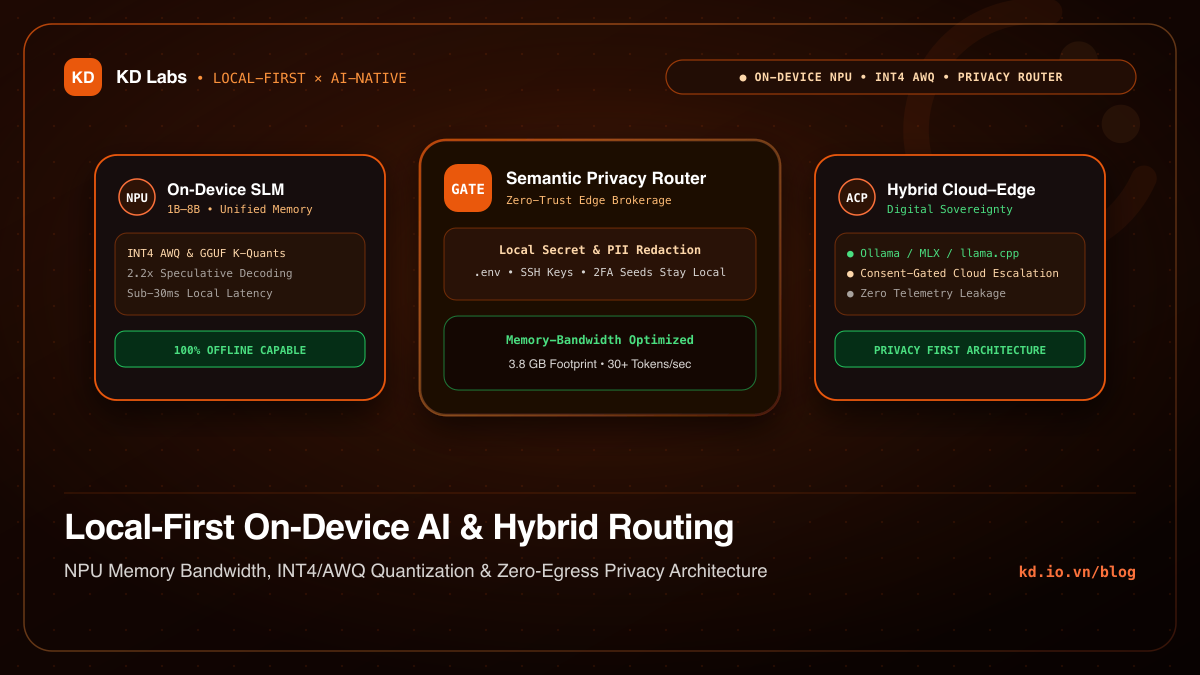
During the initial wave of generative AI, nearly every intelligent feature shared the same architecture: serialize raw user data into JSON and ship it over HTTPS to a multi-megawatt cloud GPU cluster. Yet 100% cloud-dependent AI quickly hits three structural walls: unacceptable privacy exposure (proprietary source code, credentials, financial and personal records), per-token inference costs that scale linearly with active users, and network round-trip latency incompatible with sub-50ms interactive UX.
Today, the convergence of dedicated Neural Processing Units (NPUs / Apple Neural Engine), high-bandwidth Unified Memory architectures, and capable Small Language Models (SLMs in the 1B–8B parameter class) is unlocking a transformative paradigm: Local-First AI-Native Software.
1. The Physics of Local Inference: Conquering the Memory-Bandwidth Wall
Developers new to local inference often assume token generation speed on laptops and phones is bottlenecked by raw compute (TOPS / TFLOPS). In reality, Transformer inference consists of two hardware-distinct phases:
- Prefill Phase (Prompt Ingestion): Processes all input prompt tokens in parallel via dense matrix-matrix multiplications — strictly Compute-Bound.
- Decode Phase (Autoregressive Token Generation): Generating each individual output token requires streaming every single model weight from DRAM into SRAM compute units — making autoregressive decoding overwhelmingly Memory-Bandwidth-Bound!
The theoretical ceiling for single-batch token generation follows a remarkably simple law:
Max Throughput (Tokens/s) ≈ Memory Bandwidth (GB/s) / Model Weight Footprint (GB)
Consider a developer laptop with 120 GB/s unified memory bandwidth running a 7-billion-parameter (7B) model:
- In native FP16 (2 bytes per parameter): Weights occupy
~14 GBof RAM → theoretical peak throughput caps at120 / 14 ≈ 8.5 tokens/s(noticeably sluggish). - Quantized to INT4 (0.5 bytes per parameter): Weights shrink to
~3.8 GB→ peak throughput jumps to120 / 3.8 ≈ 31.5 tokens/s(effortless real-time streaming)!
2. Outlier-Preserving Quantization (AWQ, GGUF K-Quants & QAT)
Compressing weights from 16-bit floats to 4-bit integers via naive uniform rounding destroys emergent outlier activation channels inside Transformer layers, severely degrading code synthesis and multi-step logic.
Modern quantization algorithms preserve reasoning fidelity through mixed-precision sensitivity allocation:
| Quantization Technique | Fidelity Preservation Mechanism | Ideal Execution Target |
|---|---|---|
| AWQ (Activation-Aware Weight Quantization) | Identifies the top 1% salient weight channels based on calibration activation magnitudes and scales them to prevent clipping error. |
Local GPUs, Apple Silicon MLX, high-throughput developer workstations. |
GGUF K-Quants (Q4_K_M, Q5_K_M) |
Uses hierarchical super-blocks; retains sensitive attn_v and ffn_down tensors at 5/6-bit while compressing bulk matrices to 4-bit. |
Cross-platform CPU + GPU + NPU execution via llama.cpp. |
| QAT (Quantization-Aware Training) | Simulates 4-bit quantization noise directly inside forward passes during fine-tuning so weights adapt natively to low-bit representations. | Ultra-low-power mobile NPUs (Core ML, Qualcomm Hexagon, Android AICore). |
Pairing 4-bit quantization with Speculative Decoding — where a tiny 0.5B draft model rapidly proposes 5 candidate tokens and the 8B target model verifies all 5 in a single parallel memory read — delivers up to a 2.2× speedup with mathematically lossless output distribution!
3. Privacy-Preserving Hybrid Cloud–Edge Routing
Pragmatic AI-Native systems rarely treat local and cloud inference as mutually exclusive. Instead, they implement a client-side Zero-Trust Semantic Router that enforces strict data-sovereignty boundaries before a packet ever touches a network socket:
                      [ Incoming User / IDE Intent ]
                                    │
                                    ▼
        ┌───────────────────────────────────────────────────────┐
        │    LOCAL PRIVACY GATE & SECRET/PII SCRUBBER (NPU)     │
        │   Detects API Keys, .env Secrets, Tokens & PII Spans  │
        └─────────────┬───────────────────────────┬─────────────┘
     Latency-Critical │                           │ Complex Multi-File Task
     or Sensitive Data▼                           ▼ (Redacted & User-Approved)
┌─────────────────────────────────┐ ┌─────────────────────────────────────┐
│   ON-DEVICE SLM (1B–8B Model)   │ │  FRONTIER CLOUD AGENT (via ACP/TLS) │
│ • Sub-30ms Inline Completions   │ │ • 20-File Architectural Refactors   │
│ • Local Semantic Search & Triage│ │ • Parallel Best-of-N Worktree Runs  │
│ • 100% Offline • Zero Token Cost│ │ • Governed by Machine Security Gate │
└─────────────────────────────────┘ └─────────────────────────────────────┘
This hybrid topology delivers the best of both worlds:
- Strict Zero-Egress Local Execution: Any workflow touching
.envsecrets, cryptographic keys, private personal records, local vector indexing, or high-frequency inline predictions executes strictly on-device with zero network telemetry. - Consent-Gated Frontier Escalation: Heavyweight architectural synthesis routes to frontier cloud models only after passing local secret scrubbing and explicit developer authorization.
4. How Local-First Meets AI-Native at KD Labs
At KD Labs, uniting AI-Native capability with Local-First Digital Sovereignty sits at the heart of everything we build:
- In Simple OTP, we enforce a strict 100% Offline Architecture (Zero Network Permissions) backed by hardware
AES-256-GCMencryption inside iOS Secure Enclave and Android StrongBox — ensuring authentication secrets never touch external servers. - In KD Code, our open Agent Client Protocol (ACP) architecture lets developers seamlessly orchestrate frontier cloud agents alongside 100% local coding agents (connecting OpenCode or custom ACP adapters to local Ollama, LM Studio, MLX, or
llama.cppinference servers) — enabling air-gapped, zero-egress autonomous coding directly inside VS Code.
As NPU memory bandwidth scales and small models continue closing the reasoning gap, Local-First AI-Native engineering is poised to become the gold standard: instantaneous, resilient offline, and uncompromising on human privacy.